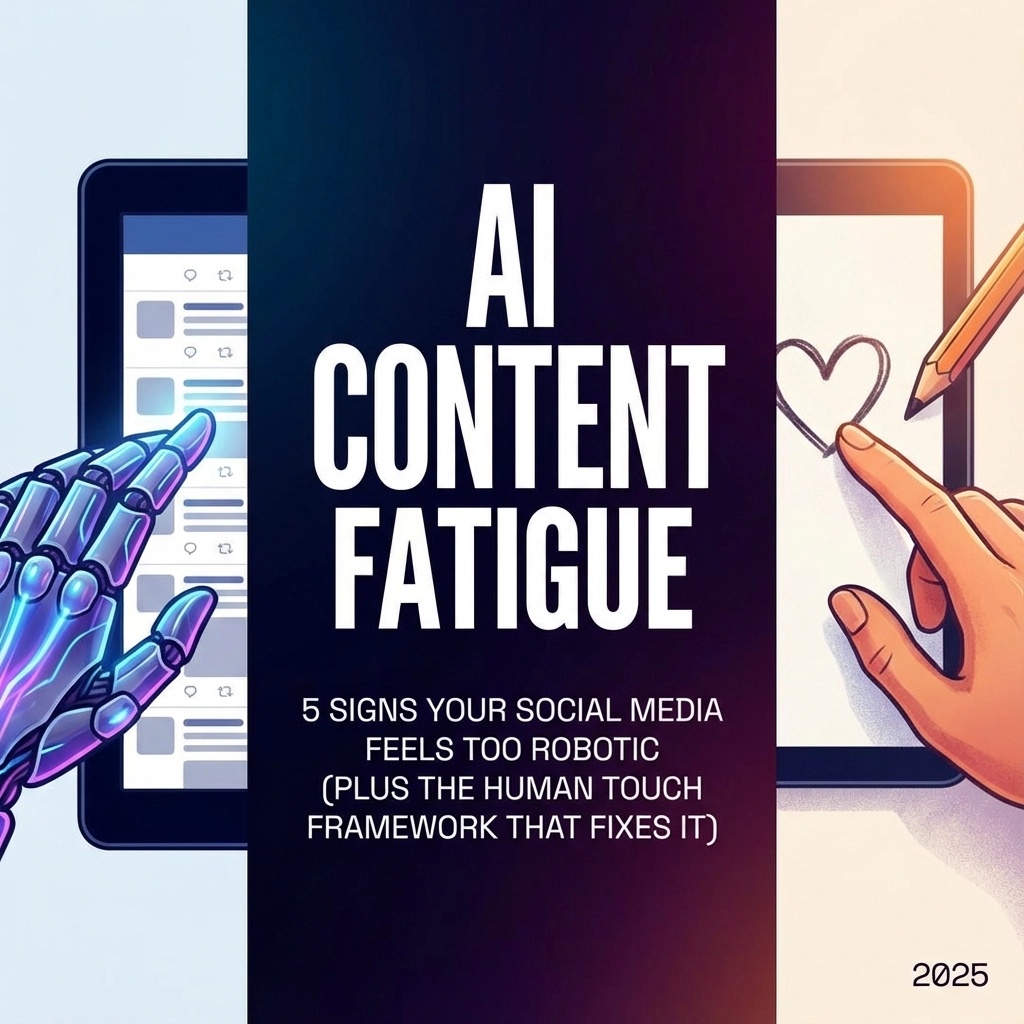
AI Content Fatigue: 5 Signs Your Social Media Feels Too Robotic (Plus the Human Touch Framework That Fixes It)
- Lucas Vandenberg
- 7 days ago
- 6 min read
Here's the uncomfortable truth: your audience is getting tired of your content, and it's not because you're posting too much. It's because you're posting content that feels like it was written by a machine, even when it wasn't.
We're living through the great AI content explosion of 2025, where tools like Jasper, Canva's AI features, and platforms like Marblism have made it easier than ever to pump out social media posts at lightning speed. But here's what nobody talks about: audiences are developing a sixth sense for detecting soulless content, and they're scrolling right past it.
At Fifty & Five, we've been watching this shift happen in real-time. Our clients come to us with declining engagement rates, confused about why their perfectly polished posts aren't landing anymore. The answer? They've accidentally stripped the humanity out of their brand voice in pursuit of efficiency.
But don't panic, this isn't a death sentence for AI tools or streamlined content creation. It's just time to get smarter about how we use them.
The 5 Warning Signs Your Content Has Gone Full Robot Mode
1. Your Captions Follow the Same Predictable Formula Every Time
You know the drill: hook, three bullet points, call-to-action, three hashtags. Rinse and repeat. While frameworks can be helpful, when every single post follows the exact same structure, your audience's brains literally tune out.

This happens because AI writing tools are trained on successful content patterns, but they don't understand when to break the rules for impact. If you find yourself unconsciously following the same template for every post, whether you're using AI or not, you've fallen into the robot trap.
The fix: Audit your last 10 posts. Do they all start the same way? End the same way? Mix it up by throwing in a question-only post, starting with a controversial statement, or sharing a behind-the-scenes moment without any formal structure at all.
2. Everything Sounds "Perfectly Professional" But Completely Forgettable
AI-generated content has a telltale shine to it, like those Instagram filters that make everything look flawless but somehow less real. Your captions hit all the right notes, use trending keywords, and sound undeniably professional. They're also completely unmemorable.
This happens when we optimize for perfection instead of connection. Real humans don't speak in perfectly crafted sentences with strategic keyword placement. We stumble, use slang, get passionate about weird details, and sometimes contradict ourselves.
The reality check: If someone covered your brand name, would your content be distinguishable from your competitors? If not, you've sanitized your voice right out of existence.
3. You're Recycling the Same "Insights" Everyone Else Is Sharing
Here's where AI content gets really dangerous: it's incredibly good at repurposing existing information and making it sound fresh. But your audience isn't stupid, they've seen "5 Social Media Trends for 2025" from fifteen different brands this week, all saying essentially the same thing with slightly different words.

The problem isn't that you're sharing industry insights, it's that you're not adding your unique perspective or experience to them. AI can research and repackage, but it can't share what happened when you actually tried that trending strategy with your client and it backfired spectacularly.
4. Your Engagement Rates Are Quietly Declining Despite Consistent Posting
This is the metric that doesn't lie. You're posting regularly, maybe even more than before thanks to AI efficiency, but fewer people are actually engaging with your content. Comments are becoming more generic, shares are dropping, and even your loyal followers seem less enthusiastic.
According to recent data, 68% of content creators report feeling exhausted by the demands of constant posting, but audiences are equally exhausted by consuming repetitive, formulaic content. It's a vicious cycle, brands use AI to keep up with posting demands, which creates more noise, which requires even more content to break through.
5. You Can't Remember the Last Time You Posted Something That Felt Genuinely "You"
This one's more subtle but perhaps most telling. When you scroll through your recent posts, do any of them make you think, "Yeah, that's totally something I would say"? Or do they all sound like they could have come from any brand in your industry?
The most successful social media accounts: whether they're personal brands or major corporations: have a distinct voice that comes through even in their most promotional content. When AI takes over too much of the process, that distinctive voice gets averaged out into generic "best practices."
The Human Touch Framework: Your Roadmap Back to Authentic Connection
The good news? You don't have to abandon AI tools entirely or go back to spending hours crafting every single post. You just need to use them more strategically while keeping the human elements that actually drive connection.
Step 1: Use AI as Your Research Assistant, Not Your Voice
AI is phenomenal at gathering information, analyzing trends, and even suggesting content angles. But the actual writing: the part where your brand personality comes through: that should stay human.

Here's how we approach it at Fifty & Five: we'll use AI to identify trending topics in our clients' industries or to analyze what's working for their competitors. But when it comes to crafting the actual message, we draw from real experiences, genuine opinions, and authentic brand voice.
Try this: Use tools like Marblism or Jasper to generate a content brief or outline, then write the actual copy yourself. You'll save time on research and ideation while keeping the authentic voice that makes people actually want to engage.
Step 2: Lead with Transparency, Not Perfection
One of the most counterintuitive findings from recent social media research is that transparent, imperfect content often performs better than polished posts. A caption that starts with "Honestly struggling with this concept, but here's what I'm learning..." will generate more meaningful engagement than a perfectly crafted thought leadership piece.
This doesn't mean oversharing or trauma-dumping on your business account. It means being honest about your process, acknowledging when you're still figuring things out, and showing the messy reality behind the polished final product.
Step 3: Inject Your Actual Opinions and Experiences
Here's where human content creators have an unbeatable advantage over AI: we've actually lived through the things we're talking about. We've tried the strategies, worked with the clients, and learned from the failures.

Instead of sharing "5 Ways to Improve Your Social Media Strategy," share "The Social Media Mistake That Cost Us Our Biggest Client (And What We Learned From It)." The second version can't be replicated by AI because it comes from genuine experience.
Step 4: Create Space for Real-Time, Unscripted Content
Some of the most engaging social media content happens in the moment: responses to breaking news, behind-the-scenes glimpses, or spontaneous thoughts that strike while you're working. This type of content is impossible to plan or automate, but it's often what creates the strongest connection with your audience.
Build time into your content strategy for these unscripted moments. Maybe it's a weekly "stream of consciousness" post where you share what's actually on your mind, or regular behind-the-scenes stories that show the real process behind your polished posts.
Step 5: Focus on Starting Conversations, Not Just Broadcasting Messages
AI-generated content is typically designed to inform or persuade, but the most engaging social media content starts conversations. It asks questions that don't have obvious answers, presents dilemmas that followers can relate to, or shares experiences that prompt people to share their own stories.

Instead of posting "Here are 3 content marketing tips," try "I'm torn between two different approaches to content marketing: curious what's worked for you?" The second version invites engagement and creates community, while the first just broadcasts information.
The Fifty & Five Approach: Where Strategy Meets Soul
At Fifty & Five, we've built our entire approach around this balance between strategic efficiency and authentic human connection. We use AI tools to amplify our capabilities: for research, trend analysis, and initial ideation: but we never let them replace the human insights and genuine voice that make content truly resonate.
Our human-centric philosophy recognizes that behind every brand account is a real person with real opinions, experiences, and perspectives worth sharing. The magic happens when we can scale that authentic voice without losing its essence.
The future of social media isn't about choosing between AI efficiency and human authenticity: it's about strategically combining both to create content that's both sustainable to produce and genuinely valuable to consume. Because at the end of the day, people don't follow brands; they follow the humans behind them.
Ready to bring the human touch back to your social media strategy? The robots can help, but they can't replace the irreplaceable: your unique perspective, genuine experiences, and authentic voice. That's what will cut through the noise in 2025 and beyond.